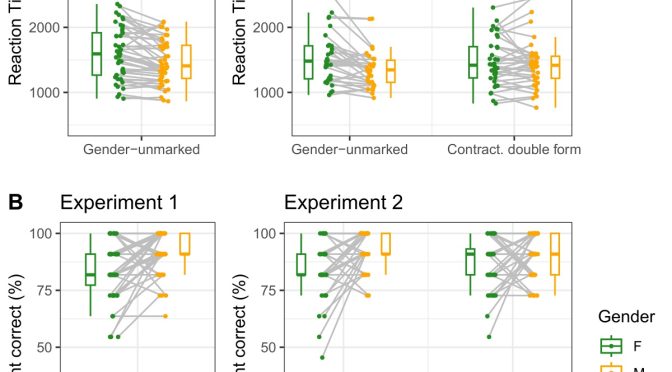
For decades, gender-fair language has fueled impassioned societal debates, often polarized between ideological positions and anecdotal claims. In this context, psycholinguistics offers a scientific lens to examine the cognitive implications of grammatical choices such as generic masculine forms (e.g., les chercheurs to refer to male and female researchers), doubled forms (e.g., chercheurs et chercheuses), gender-unmarked forms (e.g., les scientifiques), collective nouns (e.g., le personnel de rercherche) or the use of the middle dot (e.g., chercheurs·euses). Through empirical investigation, our work aims to clarify how these linguistic variations influence the mental representations activated in the readers’ mind.
While generic masculines (e.g., les médecins to refer to a mixed-gender group) are often assumed to be inclusive, psycholinguistic studies suggest they may activate male-biased mental representations. By systematically comparing the effects of different linguistic forms, we seek to quantify the strength and real-world significance of these effects. This research does not aim to prescribe linguistic norms but to provide evidence-based insights into a debate too often disconnected from empirical reality.
Administrative details:
Collaborators: Elsa Spinelli, Sharon Peperkamp